
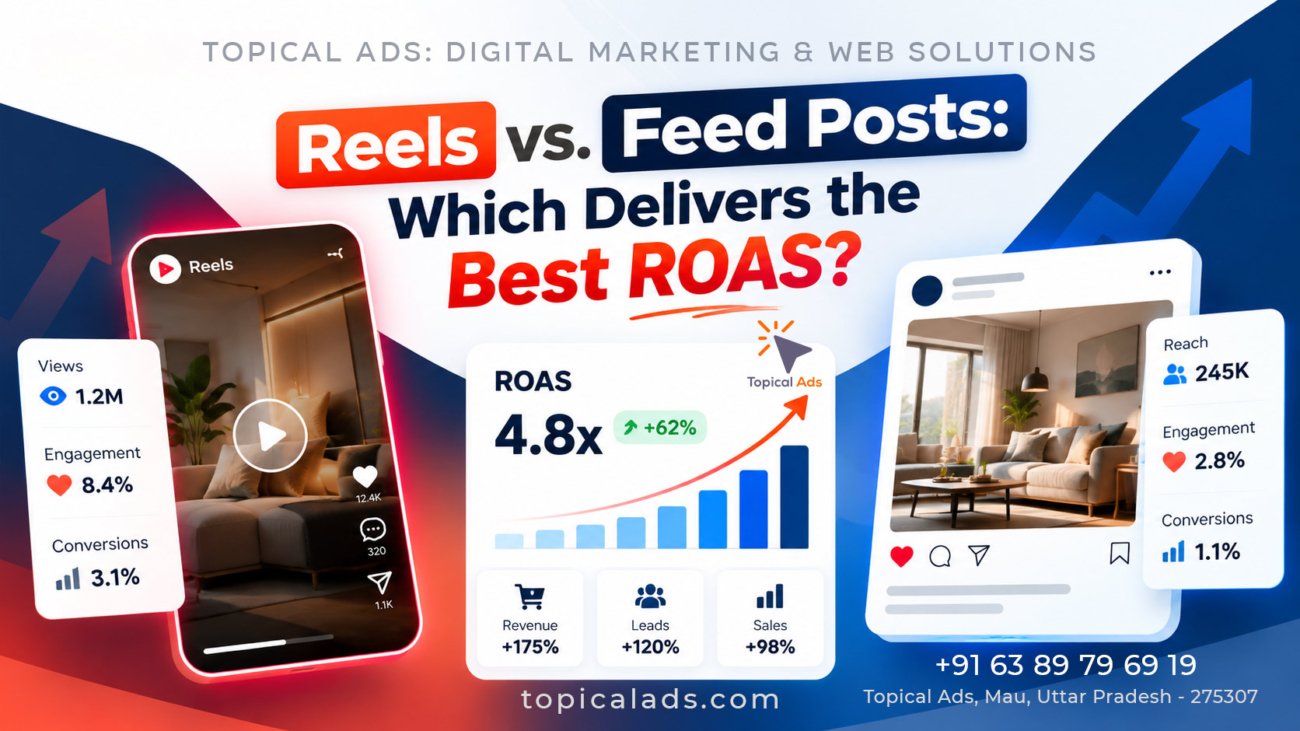
The Ultimate Ad Spend Dilemma: Reels or Feed Posts?
If there is one question that keeps performance marketers and business owners up at night, it’s this: “Where should I put my ad budget to get the highest Return on Ad Spend (ROAS)?”
Over the last few years, the digital advertising landscape has undergone a massive shift. Short-form video has completely taken over our screens, with platforms heavily favoring dynamic, fast-paced content. But does high engagement automatically translate to high conversions? Or does the classic, static feed post still hold the crown when it comes to actually driving sales and generating qualified leads?
The truth is, blindly throwing your budget at the newest trend—or stubbornly sticking to old formats—is the fastest way to burn through your ad spend. The “Best ROAS” doesn’t come from guessing; it comes from understanding the psychology behind how users interact with different ad placements.
In this breakdown, we are putting Instagram and Facebook Reels head-to-head against traditional Feed posts. We’ll look at the data, the user intent, and the exact strategies we use at Topical Ads to squeeze every ounce of ROI out of our clients’ campaigns.
Let’s dive into which format actually wins the ROAS battle.
The Numbers: Reels vs. Feed Ads
Looking at the latest 2026 cross-industry benchmarks, the performance gap between these two formats is stark. They are not competing against each other; they are playing two entirely different sports.
Instagram/Facebook Reels
- Average CPM ~$7.40 (Cheapest on Meta)
- Conversion Rate ~1.8%
- Average CTR ~0.74%
- Best Use Case Cold Audience Prospecting
Facebook/Instagram Feed
- Average CPM ~$11.50 – $13.60
- Conversion Rate ~2.8%
- Average CTR ~1.20% – 1.50%
- Best Use Case Retargeting & Closing
The Case for Feed Posts (The Conversion Anchor)
Why Static Ads Still Command Premium ROAS
With all the hype surrounding short-form video, it is easy to assume that static feed posts (single images or carousels) are a thing of the past. But in the world of performance marketing, the feed post remains an absolute powerhouse for bottom-of-the-funnel conversions.
Why? Because of user intent and consumption speed.
When a user is scrolling through their feed and stops on a static image or a carousel, they are in a reading mindset. They have the time to absorb a headline, swipe through features, and read a detailed caption.
Here is where Feed Posts dominate the ROAS charts:
- Retargeting Campaigns: If someone has already visited your landing page, a highly targeted static ad with a clear discount code or a strong Call-To-Action (CTA) is often the most cost-effective way to bring them back. You don’t need to entertain them anymore; you just need them to click.
- Complex Product Explanations: Carousels allow you to break down features, pricing comparisons, or step-by-step processes (like explaining a specialized service) far better than a fast-moving video.
- Lower Cost Per Mille (CPM): Because video inventory is highly competitive, static ads often benefit from lower CPMs. If your ad creative is highly relevant, a lower CPM directly translates to a higher ROAS.
The Verdict for Feed Posts: They are your closer. While they might not reach millions of new accounts overnight, they are incredibly efficient at converting warm audiences into paying customers.
The Case for Reels (The Attention & Scale Engine)
Why Short-Form Video is Your Best Tool for Prospecting
If Feed posts are your closers, Reels are your ultimate prospectors. Video advertising has fundamentally changed how we capture new audiences. While a static ad might struggle to grab the attention of a completely cold prospect, a well-crafted Reel can stop the scroll, educate, and entertain—all in under 15 seconds.
A common misconception is that Reels automatically yield a lower ROAS just because their direct, immediate conversion rate might trail behind traditional posts. The reality? Reels often win the ROAS battle through sheer cost-efficiency and scale.
Here is where Reels dominate the ROAS charts:
- Drastically Lower Advertising Costs (CPMs): Recent benchmarks show that Reels placements benefit from significantly lower CPMs (Cost Per Mille) than Feed posts—sometimes 15% to 30% cheaper. Because platforms like Meta are heavily pushing short-form video inventory, advertisers are rewarded with cheaper reach. If your video hook is strong, you are getting eyes on your brand for a fraction of the cost.
- The Power of UGC (User-Generated Content): For eCommerce, tech gadgets, and impulse-buy products, authentic-looking Reels consistently outperform highly polished studio photography. Showing a product “in the wild” or being reviewed by a real person builds instant social proof and desire.
- Massive Top-of-Funnel Discovery: Reels are built for algorithm-driven discovery. They push your brand to non-followers who didn’t even know they needed your product. At Topical Ads, we frequently use fast-paced Reels to flood the top of our clients’ marketing funnels with highly engaged, low-cost traffic. We then build custom audiences from those video viewers and retarget them to secure the final sale.
The Verdict for Reels: They are your growth engine. If your goal is to scale aggressively, lower your overall cost to acquire a new customer, or showcase a product in action, Reels offer the highest upside potential. However, they require a native, entertainment-first approach—if it looks like a traditional boring commercial, users will swipe past it in a millisecond.
The Winning Strategy – How to Combine Both for Maximum ROAS
Stop Guessing and Start Stacking Your Campaigns
The debate shouldn’t actually be Reels vs. Feed Posts. The businesses seeing the absolute highest returns aren’t choosing one over the other; they are actively combining them into a full-funnel strategy. Relying on just one format leaves money on the table.
To achieve the best possible ROAS, you need to align the ad format with the buyer’s journey. Here is the blueprint we use at Topical Ads to drive consistent, high-converting results for our clients:
Step 1: The Reel Hook (Top of Funnel) Start by running native, engaging Reels to broad audiences. Your goal here isn’t necessarily an immediate sale—it’s cheap reach and engagement. Use this placement to stop the scroll, introduce the problem, and showcase your product in action (UGC works best here). Because video CPMs are lower, you are building a massive pool of interested prospects for a fraction of the cost.
Step 2: The Feed Post Closer (Bottom of Funnel) Now, take everyone who watched at least 50% of your Reel (or clicked through to your site) and retarget them with a Feed Post. This is where you deploy your static images or carousels. Hit them with a strong value proposition, a clear breakdown of benefits, customer testimonials, or a limited-time discount. They already know who you are; now, you just need to close the deal.
Why This Works: This strategy leverages the algorithm’s preference for video to acquire cheap traffic, while utilizing the high-conversion nature of static posts to secure the sale.
Ready to Stop Wasting Ad Spend? Figuring out the perfect balance between video and static assets takes testing, data analysis, and constant optimization. If your campaigns are flatlining or your ROAS isn’t where it needs to be, you don’t have to figure it out alone.
At Topical Ads, we specialize in designing custom, data-driven ad strategies that utilize the best of both Reels and Feed posts to maximize your return.